BORROWER A · RECOVERING
The account is current and capacity is improving.
Temporary job disruption has ended. The borrower has returned to employment and resumed sustainable payments. A cure may be consistent with an improving financial position.
IFRS 9 asks creditors to look forward. When borrowers repeatedly dip into and out of delinquency, a payment ledger shows each cure, but not necessarily the vulnerability that persists beneath it. SimONE connects live borrower context, longitudinal behaviour and policy-governed intervention.
A borrower catches up. The account returns to current. Yet the borrower may still be juggling essential bills, living with irregular income or facing a deteriorating ability to repay. A cured arrears episode does not, by itself, establish that the underlying credit risk has returned to its previous level.
SimONE adds an engagement-driven view of that continuing vulnerability. Its Financial Vulnerability Risk Scoring Index (FVRSI) converts information about cause, severity, affordability and propensity to pay into governed treatment paths, while successive engagements can reveal whether the situation is changing.
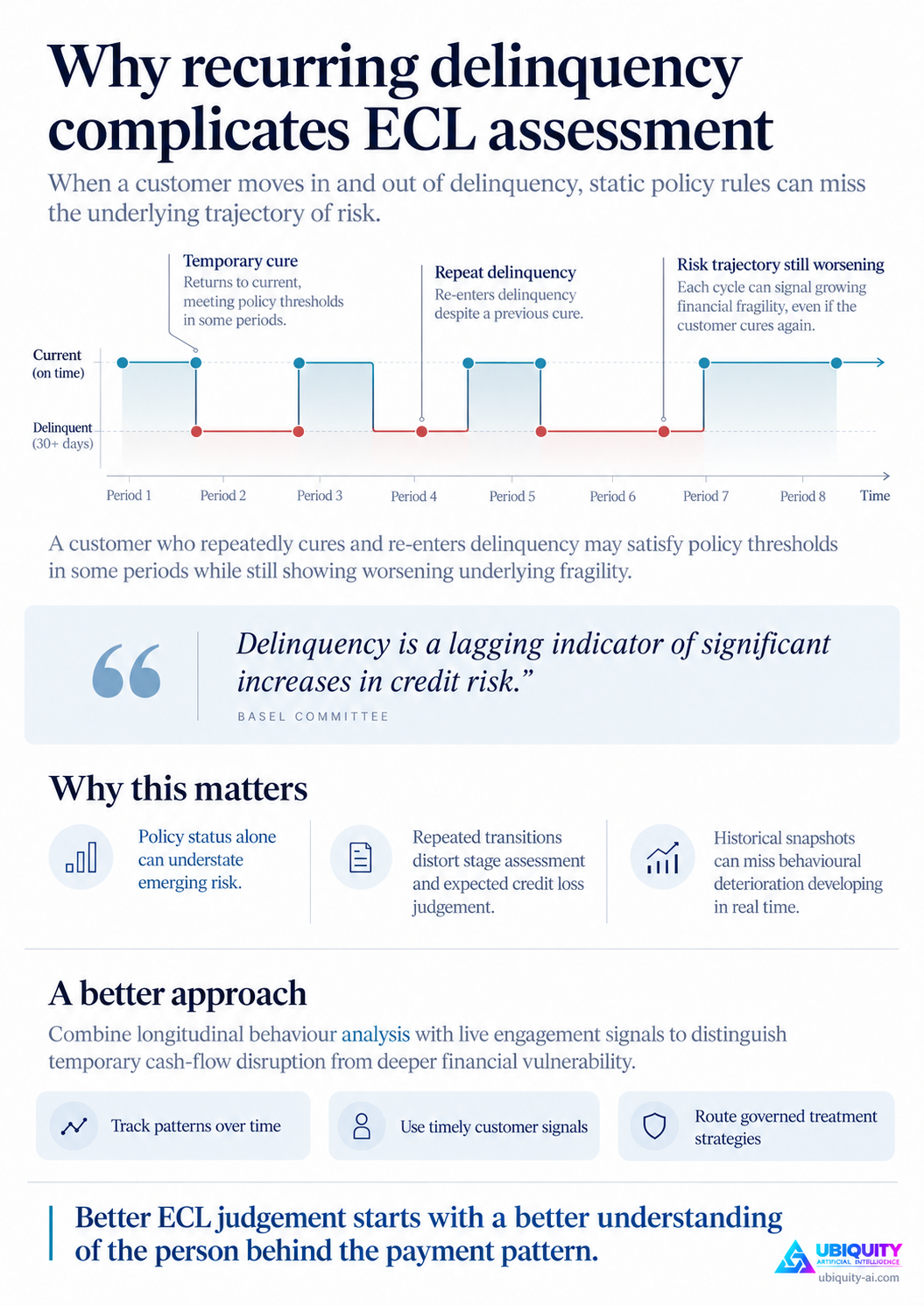
Picture a customer who alternates between paying and falling behind. In one reporting period the account is overdue; in the next, it is current again. A conventional arrears report captures every transition. Well-designed credit-risk models can also incorporate those transitions, payment histories and behavioural scores. What neither the payment status nor the history alone necessarily explains is why the pattern persists.
One borrower may be deliberately rotating limited cash between credit cards, rent, food and utilities. Another may have irregular earnings and misaligned debit-order dates. A third may have lost employment and begun using short-term borrowing to remain current. These borrowers can show similar payment patterns while following very different future risk trajectories.
Temporary job disruption has ended. The borrower has returned to employment and resumed sustainable payments. A cure may be consistent with an improving financial position.
The borrower has made up the arrears by postponing another bill or using expensive credit. The account looks cured; the household's future repayment resilience may have weakened.
The question is not simply whether the payment arrived. It is whether the customer's capacity to keep paying has changed.
The IFRS 9 expected credit loss (ECL) framework is explicitly forward-looking. It requires entities to assess whether credit risk has increased significantly since initial recognition (SICR) and to reflect reasonable and supportable information about past events, current conditions and forecasts of future economic conditions when measuring expected losses. Depending on the requirements applicable to the exposure, that affects whether 12-month or lifetime ECL is recognised.
IFRS 9's application guidance explains that changes in credit risk often arise before arrears appear, and that forward-looking information should not be disregarded in favour of past-due data when it is reasonably available without undue cost or effort. The Basel Committee similarly describes delinquency as a lagging indicator and calls for borrower-specific risk drivers, sound measurement processes and feedback from realised losses. See the IFRS Foundation and Basel Committee sources below.
That is the commercial relevance of timely, borrower-level intelligence: a lender can potentially distinguish a genuinely improving borrower from one whose intermittent cures mask persistent vulnerability. In a well-governed ECL process, those signals may be evaluated alongside existing delinquency histories, macroeconomic forecasts, behavioural models and risk controls.
Better information does not always mean a lower ECL estimate. It can support higher expected losses where deterioration has been missed, or lower expected losses where credible recovery has taken place. The aim is a more faithful view of risk and more timely action, not mechanically reducing provisions.
SimONE's Financial Vulnerability Risk Scoring Index (FVRSI) is a proprietary ten-band framework. It seeks to establish the nature, severity and persistence of financial vulnerability using structured customer engagement and relevant context. A failed transaction, seasonal cash-flow mismatch, acute job loss, long-term unemployment and severe inability to pay require different responses.
The resulting FVRSI band guides an appropriate, institution-approved treatment strategy. The longitudinal view is what becomes particularly important for creditors: a band observed today can be reassessed as circumstances and behaviour evolve.
One conversation can explain a payment failure. Repeated, lawful engagement can help explain whether the cause remains unresolved. For example, a borrower may initially report retrenchment, later reveal continuing unemployment, then begin rotating obligations to protect essential spending. Alternatively, new income may restore affordability and make a sustainable payment arrangement possible.
Over time this can create a documented trajectory: not just whether arrears were cured, but whether affordability stabilised, vulnerability persisted, commitments held or risk signals deteriorated again. That is the difference between a payment event and a continuously informed view of the customer relationship.
This matters even when a customer never formally defaults. Repeated near-misses, payment rotation, short-lived cures and increasingly unrealistic commitments may indicate fragility that warrants review before a more serious credit event.
Validated longitudinal engagement signals may improve the timeliness, granularity or discrimination of existing early-warning and SICR assessments, and ultimately the inputs used in the lender's governed ECL methodology.
Policy-governed arrangements, suitable timing, hardship support and human escalation can help address the actual causes of payment difficulty. Where such treatment succeeds, future cash shortfalls and realised losses may fall.
The first benefit concerns risk measurement; the second concerns risk mitigation. They are related, but distinct. SimONE aims to make both possible by connecting customer truth, structured actions and observed repayment outcomes.
SimONE sits alongside existing engagement and credit systems. Customer disclosures and subsequent behaviour can be captured through established rails, processed according to institutional policies and made available for controlled review. Credit-risk, finance and model-validation teams can decide which information is sufficiently reliable for a risk-management or impairment use case.
For lenders, a serious pilot should focus on a measurable question: does engagement-derived context explain or predict outcomes that a strong baseline model does not already capture, and can appropriate treatment improve those outcomes? That requires comparisons across time and across similarly situated borrowers, not just response or promise-to-pay rates.
Meaningful measures include time to first reliable diagnosis, kept-payment arrangements, cure durability, recurrence of arrears, customer retention, days spent delinquent, risk-model discrimination and calibration, and attributable changes in future cash shortfalls. IFRS 9 use would additionally require governance over information quality, representativeness, stage-transition criteria and accounting judgments.
Ubiquity has already demonstrated structured engagement performance in a regulated-lender champion–challenger pilot. Those results show that the model deserves further examination, while the longitudinal and IFRS 9 value case can be tested explicitly with a bank. The interactive brochure presents the pilot metrics and their context.
Because the payment may have been made by rotating obligations, drawing on expensive short-term credit or delaying essentials. Payment status measures what was paid; it does not establish whether repayment capacity is sustainable.
Yes. Many models use payment histories, days past due, cures and behavioural trends. SimONE's proposed incremental value is structured, timely insight into why the behaviour is occurring and whether the underlying financial vulnerability is changing.
Once validated, a lender may consider changes in income, affordability, stated circumstances and engagement outcomes as complementary borrower-level inputs to early-warning, SICR and ECL analysis. Such signals would be used within, not instead of, the lender's approved framework.
No. The assessment must consider the risk of default and reasonable, supportable information, including the exposure's history and relevant current and forward-looking circumstances. A payment cure is one data point, not conclusive proof of recovery.
Better measurement can change ECL estimates in either direction. Separately, effective early intervention may reduce future cash shortfalls and realised credit losses. Both propositions are testable but neither follows automatically from collecting more data.
FVRSI is Ubiquity AI's Financial Vulnerability Risk Scoring Index, a proprietary ten-band framework intended to identify the nature and severity of financial vulnerability and inform governed customer treatment pathways.
These sources establish the accounting and supervisory context. The application of SimONE described here is a product and risk-management proposition for validation with financial institutions.
SimONE turns financial vulnerability into information institutions can act on. Understand the cause, observe the trajectory and intervene before a temporary setback becomes a lasting loss.
Explore the interactive SimONE product brochure →